- Blog
- Changes to EV and Hybrid Incentives in Europe
Changes to EV and Hybrid Incentives in Europe
EV and hybrid incentives in Europe are changing. See which countries support BEVs and PHEVs in 2026, and what it means for used car traders.
EV and hybrid incentives in Europe change every year.
To keep your purchases and sales profitable, you need to know which rules matter for your country and your stock.
So, what’s changing in 2026?Some countries are bringing back subsidies, and others are reducing tax benefits. There are also some changes in how hybrids are treated compared to EVs.
Let’s take a look at what’s changing by country.
New EV incentives and changes in Europe
Not all European countries are moving in the same direction.
That’s why you should check the incentive rules in both the country where you buy the vehicle and the country where you plan to resell it.
Also, it’s important to remember that many incentives apply only to new EVs.
But since these changes will affect the used market as well, so you should stay informed on both markets.
Germany
Germany’s previous EV subsidy has ended, but another one was introduced in 2026.
In this EV Incentive Programme, private buyers with low or middle incomes can get between €1,500 and €6,000 when buying or leasing new EVs registered from 1 January 2026.
Hybrids can also receive support, but at lower levels than full EVs.
This subsidy helps make new EVs cheaper and increase Germany’s EV adoption. Keep in mind that it doesn’t apply to used vehicles, just the new ones.
France
France is extending the bonus écologique into 2026.
This incentive also only applies to private buyers buying new EVs. Used cars, or even new hybrids, are not covered.
Netherlands
The Netherlands is reducing its EV road-tax discount from 2026.
Before, EV owners had a bigger tax benefit, but from 2026 to 2028, electric cars will receive only a 30% discount on motor vehicle tax.
That means EV owners will pay 70% of the regular road tax.
Since this is not a purchase subsidy, it doesn’t make EVs cheaper to buy.
Instead, it lowers the cost of owning an EV, including used EVs, although the benefit is smaller than in previous years.
Spain
Spain is moving from MOVES III to the new Plan Auto +.
The incentive program has a budget of €400 million for 2026 and is meant to make EV incentives simpler than before.
Auto + offers grants up to €4,500 for purchases of full EVs, and lower amounts for hybrids.
This incentive only applies to new cars.
Poland
Poland’s NaszEauto programme ended in 2026.
So, Poland no longer has an active purchase subsidy for new EV buyers.
However, there’s an active incentive for businesses buying EVs, in form of a more favorable tax treatment.
From 2026, companies can deduct car depreciation and leasing costs up to PLN 225,000 for electric and hydrogen cars. That’s a significant amount compared to PLN 100,000 for most ICE cars.
All in all, while Polish EV buyers are no longer supported with subsidies, EVs can still be more affordable for businesses because of the tax benefits.
Belgium
Belgium isn’t introducing any new programmes in 2026.
Still, there is an advantage that businesses can use for company EV cars.
In 2026, electric company cars remain 100% tax-deductible, while tax benefits for petrol, diesel, and many hybrid company cars are being reduced.
After 2026, this EV tax benefit will slowly become smaller, reducing to 75% by 2031.
So, EVs still get strong support through the tax system, but mainly for company cars rather than private buyers.
2025 vs 2026 incentives - a table overview
Here’s a quick look at how EV incentives changed in each country from 2025 to 2026.
|
Country |
2025 situation |
2026 situation |
Who benefits? |
|
Germany |
Previous EV subsidy has ended. |
New subsidy introduced for new EVs, with lower support for hybrids. |
Private buyers, based on income. |
|
France |
Bonus écologique was available for eligible new EVs. |
Bonus écologique continues for new EVs. |
Private buyers. |
|
Netherlands |
EVs had a bigger motor vehicle tax discount. |
EV motor vehicle tax discount drops to 30%. |
All EV owners. |
|
Spain |
MOVES III was the main EV incentive programme. |
Plan Auto + replaces MOVES III. |
Buyers of new EVs and hybrids. |
|
Poland |
NaszEauto provided purchase support for EVs. |
Purchase support ends, but business tax benefits are still here. |
Businesses buying or leasing EVs. |
|
Belgium |
No national EV purchase subsidy. |
No new programme, but company EV tax benefits remain. |
Businesses using company EVs. |
Ex-lease EVs and hybrids on eCarsTrade
Incentives may change, but ex-lease EVs and hybrids are a consistently good stock for used-car traders.
This is especially true for countries like Netherlands, Germany, and Belgium, where rules about company cars make business fleets switch to EVs and hybrids.
As these cars come back from leasing, they can become excellent sourcing options.
These vehicles are well-maintaned and come with clear documentation, so you can know exactly what you’re buying even when you’re buying online.
On eCarsTrade, you can find hundreds of ex-lease EVs and hybrids that you can buy right away.
Use the EV and hybrid filters to quickly find EVs, PHEVs, and other hybrid models that match your market.
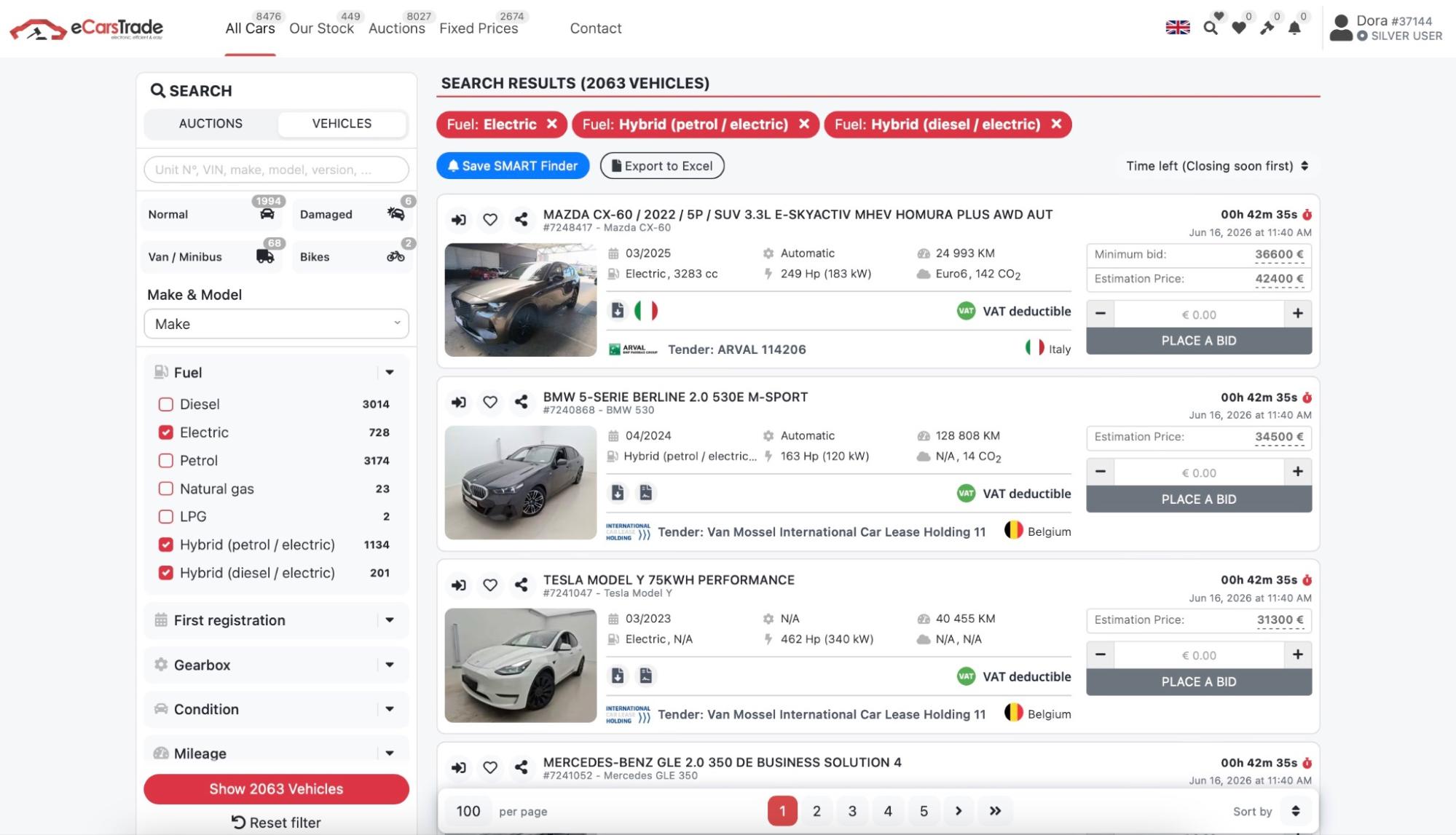
You can also compare different buying options, including auctions, buying at fixed prices, and stock vehicles.
That way, you can find EVs and hybrids that fit your sales market, without relying only on local supply.
BEV vs plug-in hybrid vehicles: incentive gap widens
Until recently, plug-in hybrids were listed as a regular type of electric vehicles.
That’s because they can drive short distances on electric power.
But since hybrids still emit CO₂, and the EU is moving toward zero-emission new cars from 2035, many governments are giving stronger incentives toward full EVs instead.
Of course, there are a lot of buyers interested in hybrids, and they still sell well.
But when it comes to government incentives, full EVs are clearly becoming the priority.
Where are plug-in hybrid purchases still supported?
PHEVs still receive some support in:
- Germany: Some hybrids qualify for lower subsidies than full EVs, but only as new vehicles.
- Spain: Plan Auto+ offers lower support for hybrids than for full EVs, also only for new cars.
- Poland: Some low-emission hybrids can still benefit businesses through tax rules.
Where is support for PHEVs disappearing?
PHEV support is being reduced or completely removed in France, Netherlands, and Belgium.
What do incentive changes in 2026 mean for your business?
Although many incentive changes apply to new cars only, they can still affect used-car businesses.
For instance, if a country supports new EVs, buyers may become more interested in electric cars in general.
But if new EVs become cheaper because of subsidies, used EVs also have to match these prices.
As always, we advise you to monitor incentive changes in your local market closely!
Demand and residual values
When a country supports new EVs, more people buy EVs.
That can help the used EV market later, especially as more ex-lease EVs become available.
The downside of this is that used-car sellers might have to lower their prices to compete with cheaper, subsidised new EVs.
This could lead to faster EV depreciation.
So, the story has two sides: demand may grow, but prices may need to come down.
Target countries for sourcing PHEV and EV
The best countries for sourcing PHEVs and EVs are the ones with high EV adoption rates.
Germany, Belgium, and the Netherlands are good examples.
EVs are already common there, so you can often find a good supply of well-maintained ex-lease EVs in these markets.
Target countries for sales
When it comes to selling, you should focus on countries where buyers are more ready for EVs.
These countries usually also have better charging infrastructure, so it’s easier to own an EV.
For PHEVs, countries like Poland, Spain, and Portugal could be good options.
Buyers there may want lower fuel costs, but still like having a petrol or diesel engine.
The best strategy is not to choose only EVs or only hybrids. You should find a good balance that fits your local market.
BEV vs PHEV: what to stock now?
The answer depends on your market. EVs receive the most support, but there’s still a big demand for PHEVs in many markets.
Let’s see where EVs or PHEVs are more likely to sell.
|
Country |
What to stock |
Why |
|---|---|---|
|
Germany |
Both, but prioritize EVs |
The 2026 subsidy covers new EVs and some range-extender hybrids, with stronger support for EVs. For used traders, EVs are the safer choice, but hybrids still sell if you adjust prices. |
|
France |
Full EVs |
France supports new EVs, while hybrids are left out of the main incentive. Selling hybrids is less profitable here because you have to price them lower. |
|
Netherlands |
Full EVs |
EVs are the better choice, but the road-tax discount is shrinking, so EV ownership is getting more expensive. Factor that into your pricing. |
|
Spain |
Both BEVs and PHEVs |
Plan Auto+ supports full EVs more strongly, but hybrids still get some support. Both can sell well if you price them correctly. |
|
Portugal |
Mostly PHEVs, some EVs |
There is solid demand for hybrids. Charging infrastructure is improving, so stocking some EVs is a smart move too. |
|
Belgium |
Full EVs |
Hybrids no longer get any support, so full EVs are the safer choice for dealers sourcing ex-lease company cars. |
What to expect in the future? 2027/28 predictions
As you can see, most countries are reducing their hybrid support, focusing on full EVs.
We can expect that trend to continue, especially considering the plans on the CO₂ reduction target.
This is where the EU Social Climate Fund becomes relevant.
The fund is meant to help households and small businesses manage the cost of switching to EVs.
Germany already has income-based EV subsidies. France also gives bigger EV subsidies to lower-income households.
So, we can expect future EV support to become more selective, not broader.
FAQ
► Which EU countries still offer EV purchase grants in 2026?
Germany, France, Spain, and some other EU countries still offer purchase grants for EVs in 2026, but most of them apply only to new vehicles.
► Are PHEVs still subsidised in the EU in 2026?
Yes, but less than BEVs.
Germany and Spain still offer some support for hybrids, but usually at lower levels than full EVs. In other countries, PHEV support is reducing.
► Will 2026 incentive changes affect used EV prices in Europe?
Yes. New EV subsidies can make the difference between new and used EV prices smaller. Tax changes can also affect ownership costs. So, you should watch both markets and price used EVs against buying and owning a new EV.
_01JE9WH8CRTMG3B3WDH56WNJHD.png)